The Complete Indian Visa Guide

Lately my subscribers asking me many questions about Indian visa so I’ve decided to create a simple and complete guide that will explain everything about the Indian eVisa.

If you follow my blog, you know I usually suggest you to use the cheapest options so you save money and use it in your trip, but in the case of visa I highly recommend you to use the help of experts, I heard of so many people who missed flights because of mistakes in their visa, so just pay a bit extra and don’t risk your trip!

Let’s start with the most common question, how should you apply for the eVisa:
There are 2 main options.
* I will make it short – use eVisa+ http://e-visaplus.com/apply/india – the easiest and safest way. But as always, I will share also the cheaper option:

  1. Directly via the Indian Immigration department’s website: https://indianvisaonline.gov.in/evisa/
    Pros:
    a. Cheapest option
    basically, other than that, I couldn’t think of other pros.
    Cons:
    a. No available support.
    b. No refunds in case of refusal.
    c. Difficult and long form.
    d. Nobody review your application before it submitted.
  2. Using an expert agency, after long reserach and reviewing over 15 different companies, I recommend you to use “eVisa+”   link: http://e-visaplus.com/apply/india
    (They also offer a coupon to my readers, Code: indiatravel5  and get 5$ off!)
    Pros:
    a. 24/7 Support via chat, email and phone.
    b. Simple and easy to use form.
    c. Money back gurantee in case of refusal.
    d. Two visa experts will review your application and detect issues before submitting your application.
    Cons:
    a. Additional service fee (as low as $44, to be honest, it’s totally worth it, don’t risk your $2000 or more trip for $44…).
    By the way, I have a coupon for my readers! 
    Code: indiatravel5  and get 5$ off!

This is me with the visa I got from eVisa+ 
 

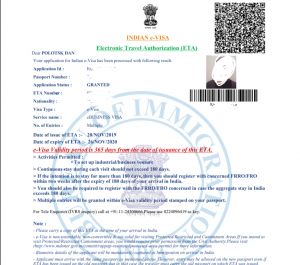
The 2nd question I will answer here is how you will get the visa and how it looks like:
You will get the visa via email and you will need to print it.
In India you will need to show the printed visa to the immigration officer whom will stamp the visa in your passport.
The eVisa looks like this:
The third question many people ask me is how long is the visa valid for:
As you might know, the Indian Immigration department made some changes in the visas lately and now there are 3 different eVisas for tourists
  1.  E-tourist visa for 30 days
    1. With this visa, once you enter the country, the visa will be valid for 30 days.
  2.  E-tourist visa for 1 year
    1. This visa is valid for 365 days, allows multiple entries and maximum stay of 90 days in India
  3.  E-tourist visa for 5 years
    1. This visa is valid for 5 years, allows multiple entries and maximum stay of 90 days in India

Another question is how and when you will get the visa.
So the eVisa is sent to you via email and you will need to print it.
Usually it takes about 3-4 business days.

I have visited India 10 times in the last 3 years, I issued 5 visas and I have a lot of experience in visas, and yet, I still choose to pay extra and use 3rd party agency so I can be sure it will be ok and I will not risk my trip for few bucks.
* Pay attention, in this field there are many scams and many website that look exactly like the official website but will charge you 5X the price!!
So be aware and only use the 2 options I shared here, the official website (the cheapest option) or an agency (I chose eVisa+ because of the affortable price and great service)

1)The Oberoi Amarvilas

The Oberoi Amarvilas is Agra’s best and most luxurious hotel. It is Situated only about 600 meters away from the Taj Mahal. it is top class when it comes to luxury, its furnishing and services are too long for. The serene environment would make your vacation worth the while. 

2) The Gateway Hotel Fatehabad

The gateway hotel Fatehabad is a big hotel which is Surrounded by six acres of landscaped gardens. the gateway hotel has 100 rooms and five executive suites. The hotel is about three kilometers away from the Taj Mahal and about five kilometers away from the railway station. The rooms are really spacious and comfortable. The services are top notch. The environment is very serene and tranquil. You can be assured of having a wonderful and pleasurable stay while in Gateway hotel Fatehabad.

3) Radisson Blu Agra

The Radisson Blu Agra Spreads across 4.5 acres of land. The luxurious hotel is just a kilometer away from the Taj Mahal. It has one hundred and forty (140) rooms. The hotel also has executive suits. The suites offer expansive views of the Taj Mahal from their large terraces. The rooms are extremely beautiful and without a doubt comfortable. The soothing environment aids relaxation. It is indeed an amazing place to relax whilst taking a break from the regular day to day stress.

4) Courtyard by Marriott Agra

The Courtyard hotel is another very beautiful hotel in Agra. It has an outdoor swimming pool which is very appealing, a spa and a fitness center to help you keep fit whilst enjoying your stay. The hotel also has a wellness center. So you can be assured of all-round care 24 hours round the clock. The hotel also has 4 dining options so you are not subjected to just one, you have an option you decide which you want. The hotel is 3.8 km away from the iconic Taj Mahal. The staffs are great and well organized as well.

5) Mansion Grand Agra

Mansion Grand Agra is built on 4.5 acres of land and just 1 km from the Taj Mahal. The  Mansion Grand hotel Agra features a health club, an infinity pool, a spa, and  5 dining options all to make your stay as pleasurable and comfortable as possible. The rooms are also Air-conditioned with free Wi-Fi and a flat-screen TV in all of the rooms. The friendly and ever welcoming staff always make sure you are treated properly. Their services are indeed top notch.

6) Hotel Clarks Shiraz Agra

Hotel Clark’s Shiraz is 1.5 km from the Taj Mahal and Agra Fort. The hotel has a beautiful swimming pool for relaxation which is open to you whenever you desire. It also has a massage parlor, a wellness center, and a spa to ensure you are very comfortable and fully enjoy your stay. However, the Wi-Fi is only available for one hour per day. The hotel has a Mughal room that serves Chinese and Indian dishes. While if you desire to enjoy refreshing beverages, you can just stroll into the Mughal Bar and you will be served. And if you desire to dine privately, the room service will deliver to your room.

The weather condition in India cannot be generalized because of the vast geographic scale and wide range of climates. This is exactly why those seeking to visit this amazing country for the first time would have to pay close attention to the weather condition of the region they plan on visiting.

Like most countries, the meteorological department of India has identified four (4) major weather conditions that everyone seeking to travel to this country should take to heart.

1. Winter;

This is the coldest season in the country, and this is because, during these months, vertical rays of the sun moves south of the equator, thus, making the country experience a cool weather condition. While this season usually starts from October and runs to February, you will find it interesting to know that the months of December and January happen to be the coldest months. During the month of December and January, Indian Himalayas get to experience the lowest temperature while the east and south region of the country experiences high temperatures.

Times where the annual snowfall in the country is at 50mm or below, some of the Himalayan states (Kashmir and Jammu located in the north, Sikkim, Arunachal Pradesh, and Himachal Pradesh) experience heavy snowfalls. Nagaland and Manipur which, although not located close to the Himalayan states, tend to experience occasionally heavy rainfall. Kashmir and Jammu happen to be the worse states to visit during this period as blizzards occur disrupting travels as well as other activities. Surprisingly, North India does not receive snow at any time of the year.

2. Summer;

The summer season starts from the month of March and runs to the end of May in other parts of the country. For Northwestern India, summer season usually starts from the month of April and runs to the end of the month of June. While the Western and Southern regions of the country tend to experience summer in different months, they are all very hot during the month of April, thus, making it the hottest month in these regions. For the North region, the month of May has been described as the hottest, and most cities in this region have a temperature of 50°C.

Aside from the difference in summer months experienced in this country, one amazing thing about the summer season is “wind” which is fondly called “Loo.” Basically, they are a strong, hot, gusty, and dry wind that occasionally blow in most parts of the country. Reports have revealed that exposure to this wind may be fatal. Himachal Pradesh like the Northern region of the country tends to experience its Sumner from the end of the month of April down to the end of June. During this period, the region is always hot as it has a temperature that ranges from 28°C to 32°C.

3. Monsoon;

Otherwise referred to as the southwest summer monsoon, this is basically a four (4) month period that is characterized by massive convective thunderstorms. It is also referred to as the most productive season on Earth. This season happens to be a product of trade winds in the southeast which originates from high-pressure masses that center over the Indian Ocean located in the south. The torrents have been revealed to supply over 80% of India’s total rainfall.

This season lasts from July down to the end of the month of September. It is characterized by humid southwest summer monsoon which gradually sweeps the country. North India does not get to experience rainfall during the monsoon season until the beginning of the month of October. The Southern region of the country tends to receive more rainfall during this season.

4. Autumn season or post-monsoon season;

This season starts from the month of October and runs until the end of November. During this season, the Northeast region of India is characterized by cloudless weather. A higher percentage of the annual precipitation is received by Tamil Nadu in the Northeast region during the post-monsoon season. 

This season brings about dry, dense, and cool air masses to some of the large parts of India. Wind spill from across the Himalayas & flow down to the southwest right across the country, resulting in a sunny and clear sky. Although the meteorological department of India refers to this period as the fourth monsoon season, most weather and climate experts and sources state that there are just three seasons. Most parts of the country see this period as a transition from the wet to the dry seasons. The average temperature ranges from 28°C to 34°C.

Best Periods To Visit India

Based on the reports and weather condition statistics, it has been revealed that the months of October to March is the best time to visit most of the parts of the country. India is characterized by a diverse weather pattern, for example, the Himalayas stop the wind from getting to most parts of the country, thus, making the winter season warm and the summer season very hot.

Although the Himalayan and the Darjeeling parts of the country each have distinct seasons, you will find it interesting to know that travel is possible right from January down to December. If you plan on traveling to Darjeeling, bear in mind that the months of December and January are the coldest. The temperature in Darjeeling drops very low during the night, making it extremely cold in the month of December and January. During the day, the temperature rises to 10°C. In the months of June and July, the temperature ranges from 13°C to 19°C.

If you are planning on visiting Delhi when you travel to India, bear in mind that the best months to visit this region is between the months of October to March. These months are quite dry, and they have a moderate temperature. The months of November to February is characterized by chilly nights with temperatures dropping to as low as 8°C. March and October happen to be quite mild with the temperature averaging 30°C.

1) Diwali

Diwali is the grand festival of light. It is usually celebrated with lots of pomp and show. During this period, houses are decorated with lamps, clay, candles, and Ashok leaves. Sweets and crackers are shared between friends, families, and neighbors. It will be held on the 27th of October (Sunday) 2019

2) Holi

Holi is the vibrant festival of colors. On the day of Holi, people congregate in open all areas and apply both wet and dry colors of multiple hues on their body and on the body of others. It will be held on the  21st of March (Thursday) 2019.

3) Dussehra

Dussehra is also known as Vijayadashami. It is celebrated in different forms. It is a festival done to witness the triumph of good over evil. It will be held on the 8th of October (Tuesday) 2019

4) Navratri

The Navratri festival is usually celebrated by all in India in different ways. Generally, it is nine days of fasting, faith, and devotion. It will start From the 29th of September and end on the 7th of October (Monday) 2019.

5) Durga Puja

Durga Puja is a festival of goodness, devotion, and prosperity. The feast lasts for about 10 days. During this period, there is intense worship of the goddess Durga. For the year 2019, the festival would be on the 7th of October (Monday) 2019.

Other festivals which would take place in India which you would love to attend are

6) Janmashtami which will take place on the 24th of August (Saturday) 2019

7) Ganesh Chaturthi which will take place on  the 2nd of September (Monday) 2019

8) Gurupurab festival takes place on the 12th of  November (Tuesday) 2019.

9) Rakshabandhan will take place on the 15th of August (Thursday) 2019

10) Eid Ul Fitrtake takes place in India on the 5th of June (Wednesday) 2019.

11) the Bihu festival was held on the 13th of April (Saturday) 2019.

12) The Hemis festival will begin on the 11th of July (Saturday) 2019

13) the Onam festival, which will begin on the 1st of September (Sunday) 2019. 

14) the Pongal festival was held on the 15th of January (Sunday) 2019.

15) the Christmas celebration or festival which is celebrated by a lot of people around the globe will also be celebrated in India on the  25th December (Wednesday) 2019.

16) the Easter celebration, which is also celebrated in many countries around the globe was also celebrated in India the 21st of April (Sunday) 2019.

17) the Baisakhi festival was also held in India on the 14th of April (Sunday) 2019.

18) the Makar Sankranti festival was also celebrated on the 14th of Jan (Monday)2019.

19) The Maha Shivratri Festival was also held on the 4th of March (Monday) 2019.

20) The Basant Panchami festival is another festival that was held on the 29th of January (Wednesday) 2019.

21) The Mahavir Jayanti festival which was held on the 17th of April (Wednesday) 2019.

If you are looking for a beautiful and serene place to go for a tour amongst all the tourist attractions scattered over the globe then look no further than what Rajasthan has to offer. Rajasthan is located in northern India and by area the second largest state in India, Rajasthan boasts of rich culture and heritage, a colorful climate and exotic sightseeing spots riding on a Camel’s back that will leave a lasting impression on your mind.

One thing people complain of when choosing a tourist location is the rigors involved in procuring the country’s visa, accommodation and all that. But that is not the case with Rajasthan as securing a visa is as easy and swift as possible. You can visit indian-visas.org for more information on how to procure your visa as fast as possible so you can state your fun trip tour of the state of Rajasthan.

To enjoy the most of your tour in Rajasthan you need to have a good knowledge of the itinerary of Rajasthan so as to enable you to plan on exciting spots to visit. Therefore, we have compiled a guide with most of the exotic sightseeing spots in Rajasthan, which can help you plan for 14-day stay exploring the rich nature and culture in Rajasthan. Before we give you the guide on your tour, here are some important sights in Rajasthan:

  • You can check out attractions in the old and New Delhi, attractions here expose the vast and rich culture of Rajasthan that will leave an indelible mark in your heart.
  • The city of Agra: the city of Agra is another attraction you can explore as it boats of the Red Fort and Taj Mahal, yes Taj Mahal! You have probably been hearing of it, a 14-day trip to Rajasthan will definitely give you the chance to explore Taj Mahal.
  • You can also check out Fatehpur Sikri on your way to Jaipur, which also serves home to beautiful tourists attractions.
  • On getting to Jaipur you can get to enjoy a ride on an Elephant at Amber Fort, isn’t that mind-blowing!
  • City Palace is another place you can visit in Jaipur; also Hawa Mahal and Jantar Mantar are not left out.
  • Mandawa village and Havelis is another culture-rich attraction.
  • Enjoy a ride on a boat at Lake Pichola Udaipur.
  • Visit Denshnoke city which houses Marta Karni Temple, Jian shrine, Patwon Ki Haveli located in Jaisalmer.
  • Camel breeding farm located in Bikaner and Junagarh Fort.

The guide below can be used to structure your 14-day tour in Rajasthan:

Day 1: arrive Dehli from your current location, arrange your luggage in your selected accommodation and settle down and try to acquaint yourself with the immediate environment awaiting your adventure in the coming days.

Day 2: take your breakfast and leave for New Delhi where you can visit attractions like Red Fort, Jama Masjid, Chandani Chowk, and so on. At noon,  you can also visit Humayun’s tomb, Qutub Minar, India Gate, and Laxmin Narayan Temple, and others.

Day 3: leave New Delhi and depart for Agra, book your accommodation and later on you can visit the Red Fort and Taj Mahal.

Day 4: leave for the city of Jaipur which houses attractions Fatehpur Sikri, Panch Mahal, Cenotaph of Salim Chisti, Jama Masjid and others.

Day 5: still in Jaipur, you can visit Amber Fort, the City Palace, Hawa Mahal, and the famous Jantar Mantar.

Day 6: Mandawa should be your next stop, book your necessary accommodations, and check out it’s Havelis and villages.

Day 7: Depart for the city of Bikaner which houses Junagarh Fort and the Camel breeding farm.

Day 8: still in Bikaner, you can get to explore the shrine of goddess Markani at Deshnoke.

Day 9: arrive the city of Jaisalmer from Bikaner, visit the Fort Patwon Ki Haveli, Jain Shrines. You also visit Sam known for its Sand dunes.

Day 10: leave Jaisalmer for Jodhpur where you can visit the Mehrangarh Fort and Jaswant Thada.

Day 11: arrive Udaipur where you shall be visiting the famous Jain Shrine.

Day 12: still in Udaipur, you can enjoy a boat ride at Lake Pichola, visit the city palace and other places in Udaipur.

Day 13: take your breakfast and enjoy the day while preparing to take a flight back to Delhi, where you started your journey from.

Day 14: at dawn, you can leave for the airport to return to your home.

With the above guide, you can enjoy and make the most of your 14-day journey in Rajasthan, making unforgettable memories.

India has a lot of beautiful, amazing and special places which you would want to visit when you visit India.

1) Mcleodganj

It is one of the most beautiful places in India. It is also known as Heaven Amidst The Hills. The best time to visit the hill is between September to June. The view at night is indeed very beautiful. At night, you would literally see the stars in their glory, and it is so beautiful. Most tourist even treks around in Mcleodganj in other to derive the splendid experience. You can also check out the Kangra Fort, Bhagsu Falls, tea plantations of Kangra valley as well.

2) Andaman

Andaman is another beautiful sight to behold. It is also known as The Beach Haven. Those who love to swim and those who have an aquaphobia and intend to get rid of such phobia would be very delighted to visit Andaman. The best time to visit the Beach Haven is from November to mid-may. 

3) Binsar

Binsar is a jungle and lovers of wildlife would really love to visit. While trekking in the jungle, one could spot myriads of wildlife in the jungle. It is a great place to Explore The Realms Of Wildlife. The best time to visit the jungle is from October to November.

4) Kerala

It is another beautiful place blessed with nature. It is sometimes called the magical Gods own country. June to August and November to January is the best Time to visit Kerala

5) Kutch

Kutch is the most Beautiful Stretch Of the White Desert in India. It is a place you would love to visit and take beautiful pictures which would leave lasting and memories. The best time to visit Kutch is from November to February.

6)Assam

Assam is the  Home Of One Horned Rhinos. The aided viewing the rhinos, viewing the sceneries it also very pleasant. October to April is the best time to visit Assam.

7)Jim Corbett

Jim Corbett is An Adventurous Jungle. It is one of the best national parks in India. At Jim Corbett, you can spot tigers and other animals from a very comfortable spot without any fear of danger.

8)Udaipur

Udaipur is The Romantic City Of Lakes with a unique Rajasthani hue 

9)Mukteshwar

Mukteshwar is a little town in the state of Uttarakhand. It has a dense forest, lush meadows, rocks which many have found exciting to see and climb and many others. It is one of the new yet famous tourist places in India that many tourists have enjoyed visiting.

10)Auli

Auli is the Skiing Capital of India. During the winter, there’s lots of skiing in Auli. So, if you love skiing, being at Auli during winter will make you really happy.

11) Mumbai

Mumbai is a city you do not want to miss out on. The City Never Sleeps. There are lots of things like Bollywood, nightclubs, and many others to enjoy and keep you busy and happy all round the clock.

12)Delhi

Delhi is a beautiful city as well with beautiful architectural structure and the beautiful places. You can enjoy a live Qawwali session at Hazrat Nizamuddin’s Dargah.

13)Sikkim

Sikkim is the Home Of Ancient Buddhist Monasteries. There, you can not just see but also feel the mystical essence of Buddhism around you. It is open to visitors, and you could as well visit the host of monasteries for more experience.